
Introduction
Choosing the right investment is one of the most important financial decisions you will make. While residential plots have traditionally been a popular option, mango farmland has recently emerged as an attractive long-term investment. Today, many investors are looking beyond conventional real estate and exploring agricultural land that offers both appreciation and recurring income.
However, deciding between mango farmland vs residential plots can be challenging because both have their own advantages. Residential plots generally appreciate in value as cities expand, while mango farmland offers the potential for annual agricultural income in addition to long-term land appreciation.
Moreover, premium mango farmland combines the benefits of owning valuable agricultural land with the opportunity to earn from mango cultivation. Therefore, it has become a preferred investment for families, professionals, NRIs, and first-time investors who want to build long-term wealth.
In this guide, we’ll compare mango farmland and residential plots based on investment cost, appreciation, income potential, maintenance, legal aspects, and future growth to help you make an informed investment decision.
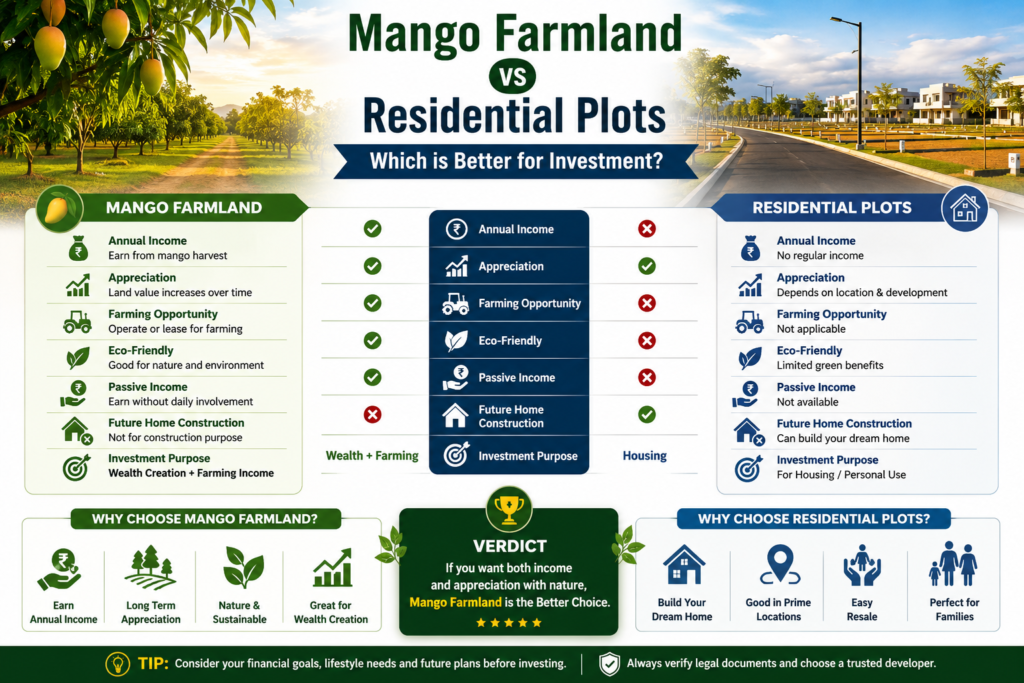
Table of Contents
- Understanding Mango Farmland
- What are Residential Plots?
- Mango Farmland vs Residential Plots
- Investment Cost Comparison
- Income Generation
- Appreciation Potential
- Maintenance Comparison
- Risk Factors
- Which Investment is Better?
- Buyer’s Checklist
- Frequently Asked Questions
- Conclusion
1. What is Mango Farmland?
Mango farmland is agricultural land developed specifically for cultivating mango trees. Unlike ordinary farmland, premium mango farms often include infrastructure such as irrigation systems, internal roads, fencing, water facilities, electricity, and professional farm maintenance.
Furthermore, many farmland projects are managed by experienced agricultural teams, making them suitable even for people with no farming experience.
Benefits of Mango Farmland
- Annual income from mango harvests
- Long-term land appreciation
- Fertile agricultural soil
- Eco-friendly investment
- Lower maintenance when professionally managed
- Tangible asset with future growth potential
Consequently, mango farmland has become a preferred investment for individuals seeking both financial returns and sustainable wealth creation.
2. What are Residential Plots?
Residential plots are land parcels designated for housing and future construction. These properties are commonly purchased for building homes or for long-term appreciation as urban development expands.
Moreover, residential plots usually appreciate based on infrastructure growth, demand, and city expansion. However, unlike agricultural land, they generally do not generate regular income unless they are developed or rented.
Benefits of Residential Plots
- Easier resale in developed locations
- Suitable for future home construction
- Good appreciation in growing cities
- Lower agricultural responsibility
- Familiar investment option
However, vacant residential plots may remain idle for years without generating any income.
3. Mango Farmland vs Residential Plots – Comparison
| Feature | Mango Farmland | Residential Plots |
|---|---|---|
| Initial Investment | Moderate | Moderate to High |
| Annual Income | Possible through mango harvests | No regular income |
| Land Appreciation | Strong in developing regions | Good in urban areas |
| Maintenance | Moderate | Low |
| Environmental Benefits | Excellent | Limited |
| Passive Income | Yes | No |
| Long-Term Wealth | High Potential | High Potential |
| Farming Opportunity | Yes | No |
| Weekend Getaway | Yes | No |
| Asset Diversification | Excellent | Good |
Overall, mango farmland provides both income potential and appreciation, while residential plots mainly depend on capital appreciation.
4. Investment Cost Comparison
The initial investment required depends on location, infrastructure, and land size.
Mango Farmland
Investment includes:
- Agricultural land
- Mango trees
- Irrigation system
- Water facilities
- Fencing
- Internal roads
- Farm maintenance
Residential Plot
Investment generally includes:
- Plot purchase
- Registration charges
- Property tax
- Site maintenance
Although residential plots may appear simpler, professionally managed mango farmland often includes value-added infrastructure that supports future productivity.
5. Income Generation
One of the biggest differences between these two investments is their earning potential.
Mango Farmland
A mature mango orchard has the potential to generate annual income through fruit production. In addition, the land itself may appreciate over time depending on location and infrastructure development.
Potential income sources include:
- Fresh mango sales
- Mango pulp production
- Processed mango products
- Agro-tourism (where applicable)
- Long-term land appreciation
Residential Plot
Residential plots generally do not produce regular income unless:
- A house is constructed and rented.
- The plot is sold after appreciation.
Therefore, many investors choose mango farmland because it combines the possibility of recurring agricultural income with long-term asset growth.
Conclusion
Both mango farmland and residential plots are valuable investment options, but the right choice depends on your financial goals and long-term vision. If your priority is building a home or investing in urban real estate, a residential plot can be a suitable option. However, if you’re looking for an investment that offers the potential for land appreciation along with agricultural income, mango farmland deserves serious consideration.
Moreover, a well-maintained mango farmland is more than just a piece of agricultural land. It has the potential to generate seasonal income through mango cultivation while benefiting from long-term growth in land value. In addition, professionally managed farmland projects often include essential infrastructure such as irrigation, fencing, internal roads, and regular maintenance, making ownership more convenient for investors.