Introduction
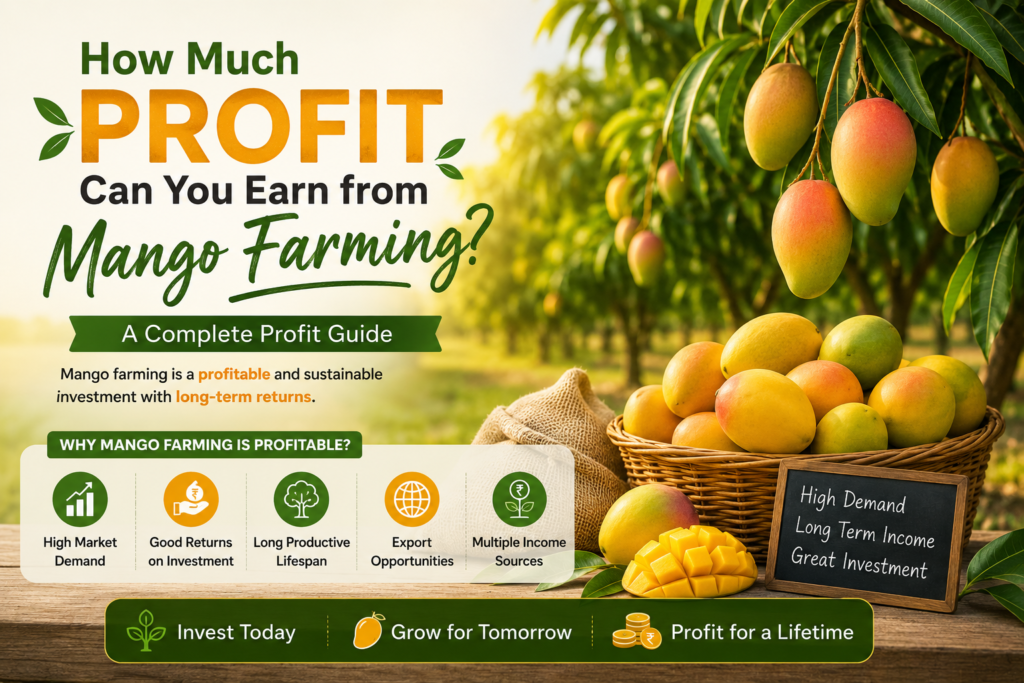
One of the most common questions asked by farmers and investors is, How much profit can you earn from mango farming? The answer depends on several important factors, including the number of trees, tree age, mango variety, soil fertility, irrigation facilities, farm management, and current market prices.
Moreover, mango farming is not a short-term business. It is a long-term agricultural investment that can provide recurring annual income for several decades. Once a mango orchard reaches maturity, the trees begin producing consistent yields every year with proper care and maintenance. In addition, the value of agricultural land often appreciates over time, making mango farming a combination of farming income and long-term asset growth.
Whether you are planning to start a commercial mango orchard or invest in premium mango farmland, understanding the expected income, maintenance costs, and return on investment (ROI) will help you make an informed decision.
Estimated Income from Mango Farming (Per Acre)
The annual income from a mango farm depends on the number of trees, their age, fruit quality, and market demand. Generally, healthy grafted mango trees produce better yields and higher-quality fruits than unmanaged orchards.
The table below provides an estimated income range for a well-maintained commercial mango orchard.
| Particular | Estimated Value |
|---|---|
| Number of Trees | 40–80 Trees |
| Average Yield Per Tree | 100–300 kg |
| Total Annual Production | 4,000–24,000 kg |
| Average Selling Price* | ₹30–₹100 per kg |
| Estimated Gross Annual Income | ₹1.2 Lakhs – ₹24 Lakhs |
Note: Selling prices vary depending on mango variety, fruit quality, location, season, and market demand.
Annual Maintenance Cost
Maintaining a mango orchard is essential for achieving healthy tree growth and consistent fruit production. Furthermore, regular maintenance improves fruit quality, reduces disease risks, and increases long-term profitability.
Typical annual maintenance expenses include:
- Irrigation
- Organic manure
- Fertilizer application
- Tree pruning
- Pest and disease management
- Labour charges
- Harvesting expenses
- Transportation costs
Estimated Annual Maintenance Cost
₹50,000 – ₹2,00,000 per acre
The exact maintenance cost depends on the size of the orchard, irrigation system, labour availability, and overall farm management practices.
Estimated Net Profit
After deducting annual maintenance expenses, a well-managed mango orchard has the potential to generate attractive returns. However, actual profits vary depending on production levels, selling prices, and operational expenses.
| Particular | Estimated Amount |
|---|---|
| Estimated Gross Income | ₹1.2 Lakhs – ₹24 Lakhs |
| Annual Maintenance Cost | ₹50,000 – ₹2 Lakhs |
| Estimated Net Profit | Depends on yield, selling price, and yearly expenses |
Therefore, farmers who focus on quality production, proper irrigation, and efficient farm management often achieve better profit margins over the long term.
Return on Investment (ROI)
Mango farming should be viewed as a long-term investment rather than a quick source of income. Initially, farmers invest in land preparation, grafted saplings, irrigation systems, fencing, and orchard establishment. However, once the trees reach commercial production, they continue producing fruits for 30 to 40 years or more with proper maintenance.
Additionally, mango farmland offers two major sources of returns:
- Annual income from mango harvests.
- Long-term appreciation in agricultural land value.
Unlike many other investments, mango farming provides the opportunity to earn recurring agricultural income while your farmland itself may increase in value over time.
Important: ROI varies based on tree age, orchard density, mango variety, climate, farming practices, and market prices. Income and appreciation cannot be guaranteed because agricultural returns naturally fluctuate from year to year.
Example ROI Calculation (Illustrative Only)
Suppose you invest approximately ₹4,00,000 to establish a one-acre mango orchard.
| Investment Details | Estimated Value |
|---|---|
| Initial Investment | ₹4,00,000 |
| Annual Maintenance | ₹1,00,000 |
| Example Gross Income | ₹6,00,000 |
| Example Net Income | ₹5,00,000 |
This example is for illustration only. Actual returns depend on orchard performance, weather, fruit quality, and prevailing market prices.
Tips to Increase Mango Farming Profit
Maximizing profit requires proper planning and consistent farm management. Moreover, adopting modern agricultural practices can significantly improve productivity.
Best Practices
- Choose premium mango varieties such as Alphonso, Imam Pasand, or Banganapalli.
- Install drip irrigation to improve water efficiency.
- Conduct regular soil testing and apply balanced fertilizers.
- Use organic manure to improve soil health.
- Prune trees regularly for better sunlight and airflow.
- Monitor pests and diseases at an early stage.
- Harvest fruits at the correct maturity level.
- Sell directly to wholesalers, retailers, or exporters whenever possible.
- Explore value-added products such as mango pulp, pickles, juices, or dried mango.
Key Takeaway
Mango farming is one of the most rewarding long-term agricultural investments when managed correctly. Overall, profitability depends on selecting fertile land, planting quality grafted saplings, ensuring reliable irrigation, maintaining healthy trees, and marketing the produce effectively.
Whether you’re a farmer, investor, or first-time land buyer, a well-maintained mango orchard has the potential to generate annual income while also benefiting from long-term land appreciation. By following modern cultivation practices and making informed decisions, you can build a sustainable and profitable mango farming business for the future.